INTRODUCATION
How to Use an Army Fitness Test Calculator to Pass the ACFT in 2025
The Army Combat Fitness Test (ACFT) has become the standard measure of physical readiness for soldiers across all U.S. Army components. If you’re preparing for this challenging assessment, you’re probably wondering how to track your progress and ensure you’re ready for test day. That’s where an Army fitness test calculator comes in handy.
Let me walk you through everything you need to know about using these calculators effectively so you can crush your ACFT in 2025.
What Is the ACFT and Why Does It Matter?
The ACFT replaced the older Army Physical Fitness Test (APFT) to better reflect the physical demands soldiers face in combat situations. Unlike its predecessor, the ACFT tests functional fitness through six events that challenge your strength, endurance, and power.
The six events are:
Maximum Deadlift (MDL) – You’ll perform a three-repetition maximum deadlift using a hex bar, testing your lower body and grip strength.
Standing Power Throw (SPT) – This event involves throwing a 10-pound medicine ball backward and overhead for maximum distance.
Hand-Release Push-Up – Arm Extension (HRP) – These aren’t your standard push-ups. You’ll lower your body to the ground, lift your hands, then push back up.
Sprint-Drag-Carry (SDC) – This is arguably the most grueling event, combining five different movements in a timed sequence.
Plank (PLK) – You’ll hold a proper plank position for as long as possible, testing your core endurance.
Two-Mile Run (2MR) – The classic running event that tests your cardiovascular fitness.
Your score matters because it affects your career progression, deployment readiness, and overall standing in your unit. Nobody wants to be that soldier who barely scrapes by or, worse, fails the test.
Understanding Army Fitness Test Calculators
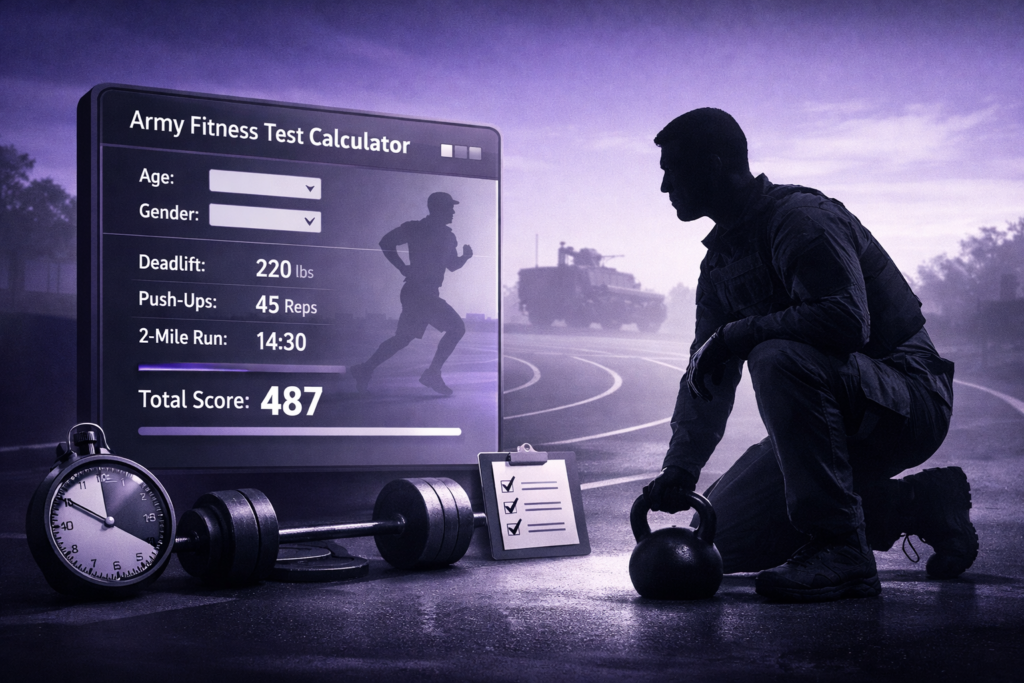
An Army fitness test calculator is basically your digital training partner. These online tools let you input your performance in each ACFT event and instantly calculate your total score. But they do so much more than just math.
The best calculators will show you exactly where you stand according to the Army’s scoring standards, which are based on your age and gender. They’ll tell you if you’re in the minimum passing zone, the moderate category, or if you’re crushing it in the significant or exceptional ranges.
What I love about these calculators is how they take the guesswork out of training. Instead of wondering whether your 140-pound deadlift is good enough, you’ll know exactly how many points you’re earning and what you need to improve.
How to Use an ACFT Calculator Step by Step
Using an ACFT calculator isn’t complicated, but you want to make sure you’re doing it right to get accurate results.
Find a reliable calculator – Search for “ACFT calculator 2025” and choose one from a reputable military fitness website or the official Army site. Make sure it’s updated with the current scoring standards.
Enter your personal information – You’ll need to input your age and gender since scoring standards vary. A 25-year-old male has different minimum requirements than a 40-year-old female, for example.
Input your performance for each event – Go through each of the six events and enter your numbers. Be honest here. There’s no point in inflating your training numbers because you’ll just be lying to yourself.
Review your score breakdown – The calculator will show you points earned for each event and your total score. Pay attention to which events are your strongest and which need work.
Identify your weak points – This is where the real value comes in. If you’re only scoring 50 points on the plank but crushing it with 90 points on the deadlift, you know exactly where to focus your training.
Set improvement goals – Use the calculator to experiment with “what if” scenarios. What happens to your total score if you improve your two-mile run time by 30 seconds? How many more points do you need on the sprint-drag-carry to move up a category?
Tips for Improving Your ACFT Score
Now that you know how to use the calculator, let’s talk about actually improving those numbers.
Train specifically for each event – Generic workouts won’t cut it. You need to practice the actual movements you’ll be tested on. Do deadlifts with a hex bar, not just regular barbells. Practice medicine ball throws from the correct position.
Focus on your weakest areas first – It’s tempting to keep working on what you’re already good at because it feels good to excel. But you’ll see bigger score improvements by bringing up your weak events. If your plank is terrible, dedicate extra time to core work.
Use progressive overload – Don’t try to jump from a 140-pound deadlift to 200 pounds in one week. Gradually increase the weight, distance, or time each training session. Your body needs time to adapt.
Practice the transitions – The sprint-drag-carry is especially tricky because you’re moving between different exercises quickly. Practice those transitions until they’re smooth and automatic.
Don’t neglect recovery – I can’t stress this enough. Rest days aren’t for the weak. They’re when your body actually gets stronger. Overtraining will just lead to injury and setbacks.
Retest regularly – Use your calculator every few weeks to track progress. Seeing those numbers improve is incredibly motivating and helps you stay on track.
Common Mistakes to Avoid
I’ve seen too many soldiers make these errors during their ACFT prep.
Only training one or two events – Maybe you’re a great runner but terrible at strength movements. You can’t ignore half the test and expect to pass. Every event matters.
Using incorrect form – Those hand-release push-ups need to be done exactly right or they won’t count. Same with the deadlift and every other event. Practice proper form from day one.
Not simulating test conditions – Training in ideal conditions is one thing. Taking the actual test when you’re tired, it’s early morning, and conditions aren’t perfect is another. Do practice tests that mimic the real thing.
Ignoring the scoring standards – Different age groups and genders have different minimums. Make sure you’re using a calculator that reflects YOUR standards, not someone else’s.
Waiting until the last minute – You can’t cram for a fitness test like you can for a written exam. Your body needs months of consistent training to develop the necessary strength and endurance.
What Score Should You Aim For?
The minimum passing score is 360 points out of 600 possible, which means averaging 60 points per event. But honestly, just passing shouldn’t be your goal.
Scoring in the 70-point range per event (420 total) puts you in a much better position. You’ll have a buffer in case you have an off day, and you’ll demonstrate genuine fitness rather than barely scraping by.
If you’re aiming for promotion or special assignments, shooting for 500+ points shows exceptional fitness. But be realistic about where you’re starting from and set incremental goals.
Making the Calculator Work for Your Training Plan
Here’s how I’d use an ACFT calculator if I were preparing for the test:
Week 1 – Take a baseline practice test and enter all your scores. This is your starting point, and there’s no shame in wherever you land. You just need to know the truth.
Weeks 2-4 – Focus on your two weakest events while maintaining the others. Retest those specific events at the end of week 4 and plug the new numbers into your calculator.
Weeks 5-8 – Shift focus to your next weakest areas. Do another full practice test at week 8.
Weeks 9-12 – Do full practice tests every other week, simulating actual test conditions as much as possible. Use the calculator after each one to track overall progress.
This cycle of test, train, retest, and calculate keeps you honest about your progress and ensures you’re not wasting time on ineffective training methods.
Final Thoughts
An Army fitness test calculator is only as useful as the effort you put into training. It’s a tool, not a magic solution. But when used correctly, it gives you clear targets, tracks your progress, and helps you focus your energy where it matters most.
The ACFT is challenging, there’s no doubt about it. But thousands of soldiers pass it every year, and with smart training and regular use of a calculator to guide your efforts, you can be one of them.
Start where you are, use the calculator to identify your gaps, train consistently, and don’t get discouraged by slow progress. Every point you earn gets you closer to passing. Every training session makes you stronger.