ACFT Standards 2025: Complete Guide to Army Combat Fitness Test Scoring & Requirements
If you’re preparing for the Army Combat Fitness Test (ACFT), you’ve probably got questions: What are the minimum standards? How do I score better? What’s actually required to pass?
I’ve helped hundreds of soldiers prepare for the ACFT, and I can tell you right now—understanding the standards is only half the battle. The other half? Knowing exactly how to train for them.
Understanding ACFT Standards is essential for every soldier, as they define the minimum and maximum performance requirements across all six events of the ACFT.
What is the ACFT? (And Why It Replaced the APFT)
The Army Combat Fitness Test became the Army’s official fitness assessment in 2022, replacing the outdated Army Physical Fitness Test (APFT). Unlike the old two-minute push-up and sit-up routine, the ACFT tests what actually matters in combat situations.
The latest ACFT Standards are designed to measure real-world combat readiness by strong strength, enhance, power, and mobility than just basic fitness.
Here’s what changed: instead of testing basic calisthenics, the ACFT measures functional strength, explosive power, and combat-ready endurance. Think less gym class, more battlefield readiness.
The 6 ACFT Events (In Order)
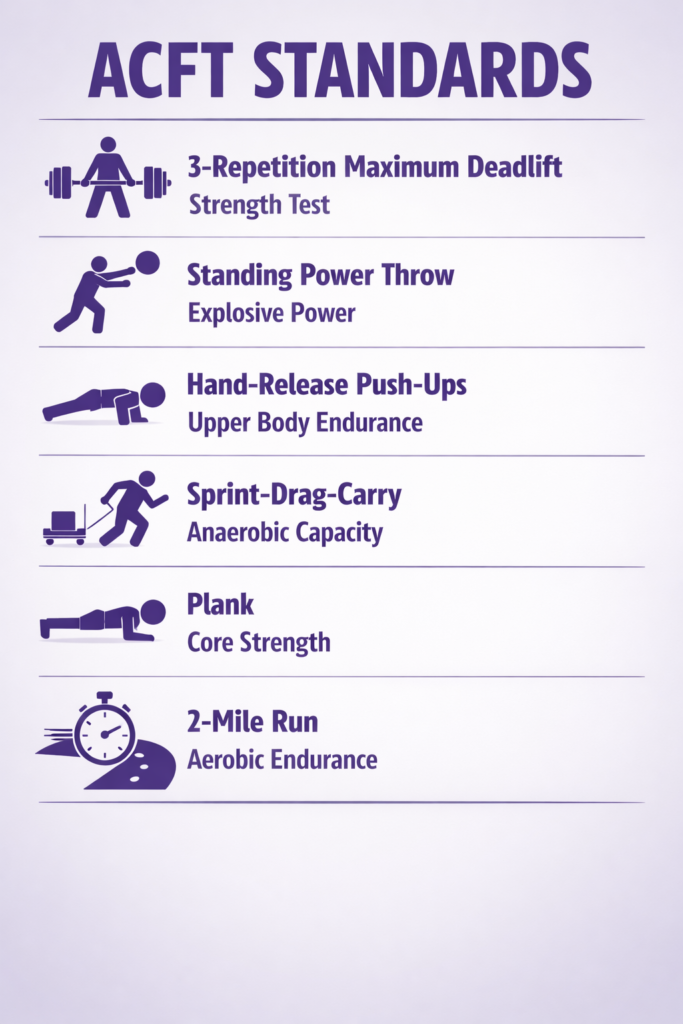
- ACFT Standards include six official events designed to measure total-body combat readiness:
- • 3-Repetition Maximum Deadlift (MDL) – Measures lower-body and posterior chain strength under ACFT standards
- • Standing Power Throw (SPT) – Evaluates explosive power as required by current ACFT standards
- • Hand-Release Push-Ups (HRP) – Tests upper-body muscular endurance based on ACFT standards
- • Sprint-Drag-Carry (SDC) – Assesses anaerobic capacity, speed, and agility according to ACFT standards
- • Plank – Measures core strength and stability under updated ACFT standards
- • 2-Mile Run – Evaluates aerobic endurance in alignment with official ACFT standards
Each event is scored 0–100 points. You need a minimum of 60 points per event to pass (360 total).
ACFT Scoring Standards by Age and Gender
Here’s where most guides get it wrong—they give you “general ranges.” That’s useless. You need actual numbers.
ACFT Minimum Standards (Age 17–21)
Event | Male Minimum | Female Minimum
Deadlift | 140 lbs | 120 lbs
Power Throw | 4.5 meters | 4.5 meters
Push-Ups | 10 reps | 10 reps
Sprint-Drag-Carry | 3:00 | 3:00
Plank | 2:09 | 2:09
2-Mile Run | 21:00 | 21:00
ACFT Minimum Standards (Age 22–26)
Event | Male Minimum | Female Minimum
Deadlift | 140 lbs | 120 lbs
Power Throw | 4.5 meters | 4.5 meters
Push-Ups | 10 reps | 10 reps
Sprint-Drag-Carry | 3:00 | 3:00
Plank | 2:09 | 2:09
2-Mile Run | 21:07 | 23:36
Maximum ACFT Scores (100 Points)
Event | Male Max | Female Max
Deadlift | 340 lbs | 230 lbs
Power Throw | 12.5 meters | 12.5 meters
Push-Ups | 60 reps | 60 reps
Sprint-Drag-Carry | 1:33 | 1:33
Plank | 4:20 | 4:20
2-Mile Run | 13:30 | 15:30
Note: Standards adjust for older age groups (27–31, 32–36, 37–41, etc.). The older you are, the more lenient the minimums become.
Event #1: 3-Repetition Maximum Deadlift (MDL)
What You’re Actually Testing
Lower body and posterior chain strength. This simulates lifting casualties, ammo cans, or equipment under load.
The Setup
Hex bar (trap bar) loaded with weights
Three consecutive deadlifts with proper form
5-minute time limit to work up to your max weight
Common Mistakes I See
Mistake #1: Rounding your back. This isn’t just bad form—it’s an automatic failure.
Mistake #2: Not fully locking out at the top. Your hips and knees must be completely extended.
Mistake #3: Dropping the bar. You have to control the descent.
How to Actually Improve Your Deadlift Score
You are not Going to Add 50 Pounds to Your Deadlift by Just Doing More Deadlifts
If your deadlift has been stuck for months, doing the same movement over and over isn’t the answer. Strength gains come from building the muscles that support the lift, improving technique, and peaking at the right time.
Here’s a proven 12-week complete plan for performance tests.
Weeks 1–4: Build the Foundation
The first phase focuses on proper form, posterior chain strength, and work capacity. The goal is not max weight, but consistent, clean reps.
Conventional Deadlifts – 3 sets of 5 reps at 70% of your 1RM
This builds technical consistency and reinforces correct movement patterns without excessive fatigue.
Romanian Deadlifts – 3 sets of 8 reps
RDLs strengthen the hamstrings, glutes, and lower back—key muscles for a stronger pull off the floor.
Barbell Hip Thrusts – 3 sets of 10 reps
Hip thrusts directly target glute power, which is critical for lockout strength in the deadlift.
Focus during this phase:
• Perfect form
• Controlled tempo
• Full range of motion
Weeks 5–8: Increase Volume and Strength
Once the foundation is set, it’s time to add volume and load, while reducing joint stress.
Hex Bar Deadlifts – 4 sets of 3 reps at 80%
The hex bar allows heavier loads with less lower-back strain and better force production.
Front Squats – 3 sets of 6 reps
Front squats improve core strength, quad drive, and posture—all of which translate directly to a stronger deadlift start.
Farmer’s Carries – 3 rounds of 30 seconds
These build grip strength, core stability, and total-body tension—often the missing link in heavy pulls.
Focus during this phase:
• Strong bracing
• Explosive intent
• Consistent weekly progression
Weeks 9–12: Peak for Performance
This final phase prepares your body and nervous system for heavy attempts and testing conditions.
Heavy Singles at 90–95% of 1RM
Low-rep, high-intensity lifts train confidence and maximal strength without unnecessary fatigue.
Hand Placement Practice
Consistent grip and setup improve efficiency and reduce wasted energy during the pull.
Explosive Drive Off the Floor
Focus on pushing through the ground hard, not jerking the bar. Speed equals strength.
Focus during this phase:
• Rest and recovery
• Mental readiness
• Precise technique.